
Surrogacy in Mexico vs Surrogacy in Colombia: Exploring the Differences

For those exploring family-building options, the choice between surrogacy in Mexico and surrogacy in Colombia involves more than geography—it’s about navigating legal frameworks, medical standards, and cultural nuances. This article breaks down the critical differences to help intended parents make informed decisions about surrogacy in Mexico vs. surrogacy in Colombia, if they are considering both of these countries for their surrogacy journey.
While both nations offer opportunities for diverse family structures, their approaches vary sharply. Colombia operates under a contract-based system with established legal precedents, ensuring smoother recognition of parental rights. Mexico’s regulations, however, differ by state, creating potential complexities for securing a birth certificate or resolving custody matters.
Key Takeaways for Surrogacy in Mexico vs Surrogacy in Colombia
Colombia’s contract-based system provides clearer legal pathways compared to Mexico’s state-level variations
Medical success rates depend on clinic expertise and available resources in each country
Parental rights recognition differs significantly between jurisdictions
Same-sex couples face distinct legal landscapes in these nations
Proper legal documentation ensures smoother transitions for the child’s citizenship status
📞 Get in Touch for a Free Surrogacy Consultation
📱 +91-8800481100 (WhatsApp | LINE | Viber)
International Surrogacy :
https://www.ivfconceptions.com/surrogacy-in-india/
https://www.ivfconceptions.com/surrogacy-in-ukraine/
https://www.ivfconceptions.com/surrogacy-in-georgia/
https://www.ivfconceptions.com/surrogacy-in-mexico/
https://www.ivfconceptions.com/surrogacy-in-usa/
https://www.ivfconceptions.com/surrogacy-in-colombia/
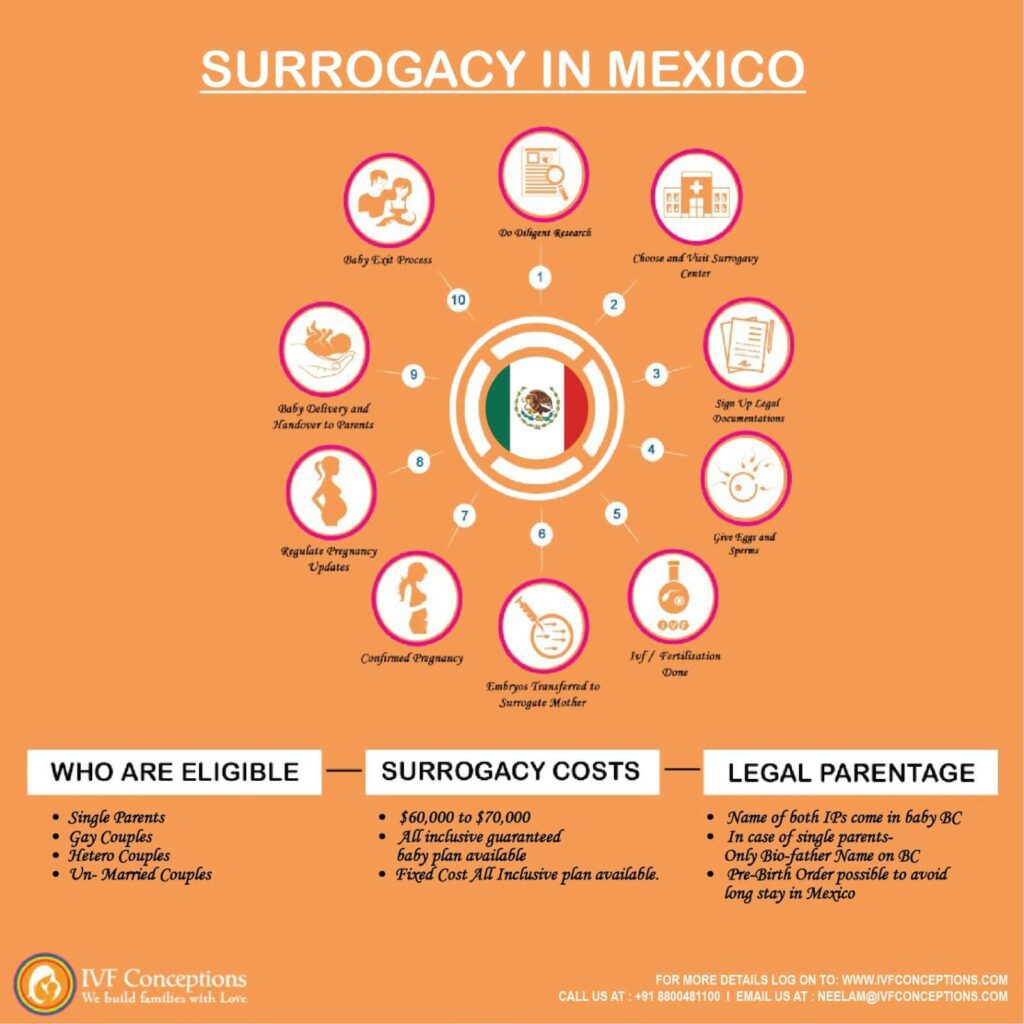
Introduction: Choosing Between Mexico and Colombia for Surrogacy
Latin America has become a hotspot for international surrogacy, especially in countries like Mexico and Colombia. But which destination is right for you?
This article breaks down the key differences in laws, costs, eligibility, LGBTQ+ access, and risks involved in pursuing surrogacy in Mexico vs Colombia, helping intended parents make a well-informed decision.
Summary Comparison Table
| Aspect | Mexico | Colombia |
| Legality | Legal in certain states (e.g., Tabasco, Sinaloa) | Legal nationwide as per constitutional rights |
| Surrogacy Type | Mostly altruistic with growing commercial programs | Altruistic and regulated compensated programs |
| Eligibility | Heterosexual & LGBTQ+ couples, singles (varies by state) | Heterosexual & LGBTQ+ couples, singles |
| Estimated Cost | \$50,000 – \$70,000 USD | \$55,000 – \$75,000 USD |
| Birth Certificate | Both parents listed in most cases | Both parents listed from birth |
| Legal Parentage Process | May require court orders or notarial steps | Relatively straightforward court process |
| Travel Requirements | Baby can exit in 6–8 weeks | Baby can exit in 6–8 weeks |
| Language & Infrastructure | English-speaking support teams available | English-speaking support teams available |
Legal Framework for Surrogacy
Mexico:
Surrogacy is not federally regulated.
Legal in specific states like Tabasco and Sinaloa.
Laws differ drastically by region.
Legal parentage may require additional court proceedings depending on the location.
Colombia:
Surrogacy is not directly regulated by legislation, but protected under constitutional rights (right to form a family).
Courts have affirmed legal protections for intended parents, including LGBTQ+ families.
More nationally consistent legal outcomes.
👨👨👧 2. LGBTQ+ and Single Parent Access
✅ Mexico:
Some states permit surrogacy for LGBTQ+ couples and singles, but others restrict access.
Intended parents should work with local legal experts to choose the right jurisdiction.
✅ Colombia:
Surrogacy is open to all, regardless of marital status or sexual orientation.
Legal precedents affirm equal access to surrogacy for all family types.
💸 3. Surrogacy Cost: Mexico vs Colombia
| Cost Category | Mexico | Colombia |
| Program Base Fee | \$40,000 – \$50,000 USD | \$45,000 – \$55,000 USD |
| IVF & Medical | Included or +\$8,000 | Usually Included |
| Surrogate Compensation | Included (varies) | Included (regulated) |
| Legal Fees | \$4,000 – \$7,000 | \$5,000 – \$7,000 |
| Total Estimated Range | \$50,000 – \$70,000 | \$55,000 – \$75,000 |
💡 Note: Guaranteed baby programs are available in both countries and may cost more depending on inclusions like donor eggs, multiple embryo transfers, or unlimited IVF.

🛂 4. Birth Certificate & Exit Process
Mexico:
In favorable states, both parents (regardless of gender) can be listed on the birth certificate.
Passport and exit documents typically take 6–8 weeks.
Colombia:
Legal parentage is secured via the court process.
Child receives birth certificate with both parents listed.
Exit timelines are similar (6–8 weeks) with proper documentation.
🏥 5. Medical Infrastructure & Surrogacy Agencies
Both Mexico and Colombia have high-quality fertility clinics with modern ART labs and experienced professionals.
Agencies often provide:
IVF coordination
Surrogate recruitment
Legal services
Translation and immigration support
🔗 Ensure your agency is licensed and offers transparent contracts and outcomes.
Guaranteed Surrogacy Programs
| Feature | Mexico | Colombia |
| Guaranteed Live Birth Program | ✅ Available | ✅ Available |
| Unlimited IVF Attempts | ✅ Offered in packages | ✅ Offered in packages |
| Donor Egg Option | ✅ Available | ✅ Available |
| Rematching if Needed | ✅ Included | ✅ Included |
These programs are ideal for intended parents over 40, those using donor eggs, or those with prior IVF failures.
Understanding the Legal Frameworks
Legal systems shape every step of building families through third-party reproduction. While some nations provide structured pathways, others leave gaps requiring careful navigation.
Colombia’s Structured System
Colombian law treats these agreements as binding contracts under civil code provisions. Courts consistently uphold these arrangements, with over 90% of cases granting parental rights to intended families within six months. One legal expert notes:
“Precedents from Constitutional Court rulings since 2019 ensure biological connections don’t dictate family recognition.”
Mexico’s Regional Patchwork
Only two states—Tabasco and Sinaloa—have explicit laws protecting all parties. Elsewhere, clinics operate in gray zones. For example:
| Aspect | Colombia | Mexico |
| Legal Basis | Nationwide contract law | State-specific codes |
| Parental Recognition | Pre-birth orders | Post-birth court petitions |
| Key Regions | Bogotá, Medellín | Tabasco, Sinaloa |
| Process Duration | 4-6 months | 8-14 months |
This disparity creates challenges. In unregulated Mexican states, obtaining a birth certificate with the intended parents’ names often requires litigation. Legal teams must file multiple petitions—a process taking up to two years in contested cases.

Surrogacy in Mexico vs. Surrogacy in Colombia: Comparing Key Aspects
Accessibility for diverse families defines modern third-party reproduction journeys. While some regions embrace inclusivity, others impose restrictive criteria that demand strategic planning.
Eligibility, Inclusivity, and Intended Parents’ Rights
Colombia welcomes all family types equally. Single individuals, same-sex partners, and heterosexual couples can pursue these arrangements without additional legal hurdles. A Bogotá-based attorney explains:
“Our courts prioritize the child’s best interests over traditional family models—parental rights stem from contractual agreements, not biology.”
Mexico’s eligibility rules shift across states. While Tabasco permits unmarried intended parents, Sinaloa restricts access to married heterosexual pairs. These variations create challenges for:
LGBTQ+ couples seeking equal recognition
Single parents establishing legal bonds
International families managing cross-border documentation
Birth Certificate Processes and Parental Recognition
Colombian authorities issue pre-birth orders through family courts. This allows legal parents to be listed immediately on the child’s documentation. The process typically concludes within 30 days of medical confirmation.
In contrast, Mexican registries often require post-birth court petitions—especially outside regulated states. A 2023 case in Jalisco took 11 months to resolve, forcing temporary foster care arrangements. Key differences include:
Colombia: Automatic naming via court order
Mexico: State-dependent litigation timelines
Thorough legal guidance proves essential. Reputable agencies now recommend dual-country counsel teams to navigate conflicting requirements and ensure parental rights security from conception through citizenship processes.

Medical Success Rates and Surrogate Care in Each Country
Medical expertise forms the foundation of successful family-building journeys. Colombia’s clinics report 65% average success rates for first attempts, compared to Mexico’s 48% in regulated states and 35% elsewhere. These numbers reflect differences in staffing, technology, and surrogate support systems.
Surrogacy Success and Clinic Experience in Colombia
Bogotá’s leading facilities employ reproductive endocrinologists with 15+ years’ experience. Continuous monitoring ensures surrogate health, with 24/7 medical access. A clinic director notes:
“Our multi-disciplinary teams handle 300+ cases annually—protocols prioritize both embryo viability and surrogate well-being.”
Standard packages include psychological support and nutritional guidance. This reduces pregnancy complications by 40% compared to global averages.
Variability of Medical Care and Support for Surrogates in Mexico
Mexico’s clinic standards fluctuate widely. While Cancún’s facilities rival international counterparts, rural areas often lack:
Advanced embryo screening technology
Certified surrogacy coordinators
Postpartum mental health resources
| Factor | Colombia | Mexico (Regulated) |
| IVF Success Rate | 68% | 52% |
| Surrogate Screening | 6-step process | 3-step minimum |
| Emergency Care Access | 100% coverage | 67% coverage |
Administrative delays in some Mexican regions add 3-6 months to timelines. Intended parents should verify clinic certifications through organizations like REDLARA before committing.
Conclusion
so, which Country is Right for You?
| Choose Mexico If… | Choose Colombia If… |
| You prefer to work in specific legal states | You want nationwide access and stable legal paths |
| You already have connections in Mexico | You seek inclusive legal recognition for all families |
| Your agency operates mainly in Tabasco/Sinaloa | You want smoother LGBT+ or single parent processing |
| You’re familiar with local travel and language | You want stronger court-established legal clarity |
Final Thoughts: Mexico vs Colombia for Surrogacy
Both Mexico and Colombia are attractive surrogacy destinations in 2025. While Mexico offers slightly lower costs, Colombia provides greater legal clarity and inclusivity, especially for LGBTQ+ and single parents.
Key Tips:
- Research legal access by state (Mexico) or through court precedent (Colombia).
- Choose reputable agencies with proven experience and bilingual support.
- Consider guaranteed programs if peace of mind and predictability are top priorities.
- Choosing between these two nations requires careful evaluation of stability versus flexibility. Colombia’s court-supported system provides predictable timelines and automatic parental recognition, while regional disparities in Mexico demand thorough legal vetting.
📞 Get in Touch for a Free Surrogacy Consultation
📱 +91-8800481100 (WhatsApp | LINE | Viber)
💫 Why Intended Parents Choose Complete Surrogacy for a Safe, Smooth & Successful Surrogacy Journey:
🌍 Access to multiple surrogacy destinations with 15+ years of international experience
🏥 Partnerships with top-tier fertility clinics and agencies, backed by references from past clients
👩🦱 Diverse egg donor options: Asian, Caucasian, African, Oriental, and more
💸 Transparent and affordable pricing—direct payments with no extra agency fees
🔒 No hidden costs—all charges are agreed upon upfront
🤝 Dedicated case manager for personalized support
📲 Fast, honest, and clear communication throughout
📑 Full legal support for visas, documentation, and baby exit processes
🚚 Assistance with frozen sperm/embryo shipment logistics

FAQs surrogacy in Mexico vs surrogacy in Colombia
How does parental recognition differ between Colombia and Mexico?
In Colombia, intended parents are typically recognized as legal parents from birth through enforceable contracts. Mexico’s process varies by state, often requiring court interventions or post-birth adoptions, creating delays and potential legal risks.
What legal protections exist for same-sex couples pursuing surrogacy?
Colombia’s framework supports diverse family structures, including same-sex couples, through clear contractual agreements. In Mexico, regulations differ regionally, with some states imposing restrictions that complicate parental rights for LGBTQ+ individuals.
Are egg donors and surrogates screened differently in each country?
Colombian clinics often follow rigorous international standards for egg donor and surrogate medical/psychological screenings. Mexican standards can vary, with some regions lacking centralized protocols, potentially affecting consistency in care.
How long does the birth certificate process take post-delivery?
Colombia’s streamlined system usually issues documents within weeks, naming intended parents directly. In Mexico, bureaucratic hurdles may extend this process to several months, depending on local regulations and court approvals.
Which country offers better medical support for surrogates during pregnancy?
Colombian surrogates typically receive comprehensive medical care through established clinics, including mental health support. Mexico’s surrogate support varies, with rural areas sometimes lacking specialized resources.
Can international intended parents secure citizenship easily for the child?
Colombia allows smoother citizenship transitions due to consistent legal recognition of parentage. Mexico’s legal uncertainties may require additional steps, such as DNA testing or consular interventions, depending on the parents’ home country.
More resources: