
Altruistic Surrogacy in India for Canadian citizens with OCI cards- Your comprehensive guide

Altruistic Surrogacy in India for Canada citizens with OCI cards
Altruistic Surrogacy in India for Canadian citizens with OCI cards is possible if you fulfill the othe all the eligibility criteria as per the Surrogacy Regulation Act (2021). What if starting a family across continents could be both ethical and accessible? For Canadian families holding Overseas Citizen of India (OCI) and looking for surrogacy in India, this possibility is closer than they might think. A growing number of hopeful parents are exploring pathways to parenthood through regulated, compassionate arrangements abroad.
India has emerged as a hub for high-quality reproductive care, blending advanced medical infrastructure with transparent legal safeguards. The Surrogacy (Regulation) Act of 2021 ensures strict ethical guidelines, prioritizing the well-being of all parties involved. Unlike commercial models, these arrangements focus solely on covering pregnancy-related expenses while fostering trust between families and surrogates.
Key Takeaways for Altruistic Surrogacy in India for Canadian citizens with OCI cards
- India’s surrogacy framework prioritizes ethics through the 2021 Regulation Act
- OCI cardholders gain simplified legal pathways compared to other foreign nationals
- Medical costs include IVF procedures and prenatal care, not surrogate compensation
- Specialized clinics offer multilingual support for international families
- Parental rights are secured through pre-defined legal agreements
📞 Get in Touch for a Free Surrogacy Consultation
📱 +91-8800481100 (WhatsApp | LINE | Viber)
💫 Why Intended Parents Choose Complete Surrogacy for a Safe, Smooth & Successful Surrogacy Journey:
🌍 Access to multiple surrogacy destinations with 15+ years of international experience
🏥 Partnerships with top-tier fertility clinics and agencies, backed by references from past clients
👩🦱 Diverse egg donor options: Asian, Caucasian, African, Oriental, and more
💸 Transparent and affordable pricing—direct payments with no extra agency fees
🔒 No hidden costs—all charges are agreed upon upfront
🤝 Dedicated case manager for personalized support
📲 Fast, honest, and clear communication throughout
📑 Full legal support for visas, documentation, and baby exit processes
🚚 Assistance with frozen sperm/embryo shipment logistics
Additional guide for surrogacy in India:
Cost of Surrogacy in Mumbai: Affordable Options
Top 5 Best Surrogacy Doctors in Mumbai With High Success Rate
Is Surrogacy in India For Overseas Citizenship of India (OCI) Allowed
Latest Surrogacy Law in India- Surrogacy (Regulation) Act, 2021
Is Surrogacy for NRI in India Allowed?
How to Find Surrogate Mothers in India
How Much Does Surrogacy Cost In India?
Legal Issues Related To Surrogacy In India
Surrogacy In India-Everything Parents Need to Know
Top 10 Surrogacy Doctors in India With Affordable Surrogacy Costs
Is Surrogacy in India For Overseas Citizenship of India (OCI) Allowed
Altruistic Surrogacy in India for USA OCI Citizens
Altruistic Surrogacy in India for Australian OCI Citizens
Altruistic Surrogacy in India for UK OCI Citizens

Altruistic Surrogacy in India for Canada citizens with OCI cards
Introduction: Latest Surrogacy in India – What Has Changed?
India was once a global hub for international surrogacy due to its affordability and medical expertise. However, the 2021 Surrogacy (Regulation) Act brought significant changes, banning commercial surrogacy and allowing only altruistic surrogacy under strict eligibility.
But what about Overseas Citizens of India (OCI) — especially Canadian citizens who hold OCI cards?
This blog explains whether Canadian OCI cardholders can pursue surrogacy in India, the legal requirements, and how to navigate the new framework.
📌 Key Considerations
- No compensation is allowed beyond medical reimbursement.
- Finding a willing close female relative who qualifies is often the biggest challenge.
- You may need to reside in India for part of the process.
- Legal support is essential to ensure full compliance with both Indian and Canadian laws.
Who is Not Eligible?
- Non-OCI foreigners (including most Canadian PR holders).
- LGBTQ+ couples or single individuals (under current regulations).
- Couples without a qualifying medical need.
- Those wishing to pay surrogates (i.e., commercial surrogacy).
What is Altruistic Surrogacy?
As per Indian law:
- Altruistic surrogacy means the surrogate mother does not receive financial compensation, except for medical expenses and insurance.
- It is only allowed for Indian citizens with specific medical conditions and within a close family or altruistic relationship.

Altruistic Surrogacy in India for Canada citizens with OCI cards
Can Canadian Citizens with OCI Cards Pursue Surrogacy in India?
Short Answer: Yes, under specific conditions.
As per the 2022 Surrogacy (Regulation) Act and guidelines issued by Indian authorities:
Canadian Citizens with OCI cards may qualify if:
- One or both intended parents are OCI cardholders.
- The couple is legally married (minimum 5 years, as per earlier ART Bill drafts; may vary).
- They have a certified medical need for surrogacy (e.g., infertility, medical contraindication).
- The surrogate is a close relative and meets eligibility criteria.
- They reside in India during the surrogacy process or maintain a permanent connection.
- The surrogacy is strictly altruistic (no compensation to the surrogate, only medical reimbursement).
⚠️ Canadian couples without OCI cards cannot currently access surrogacy in India, even for altruistic reasons.
Key Legal Requirements
| Requirement | Details |
| OCI Card | At least one parent must hold a valid OCI card |
| Marital Status | Heterosexual, married couple |
| Surrogate Relation | Can be anyone |
| Medical Eligibility | Must prove infertility or medical reason with certification |
| Surrogacy Certificate | Issued by appropriate authority after verification |
| Embryo Transfer Location | Must be conducted at a registered ART clinic in India |
| Citizenship of Child | Child will be entitled to Indian citizenship and can apply for Canadian citizenship after birth |
Overview of Altruistic Surrogacy in India
Altruistic surrogacy involves a woman voluntarily carrying a child for the intended parents without financial gain beyond medical and pregnancy-related costs. This contrasts with commercial models, where surrogates receive additional compensation. Under India’s 2021 legislation, only gestational surrogacy—where the surrogate has no genetic link to the child—is permitted.
| Aspect | Gestational | Traditional |
| Genetic Connection with Surrogate | No biological link | Surrogate’s egg used |
| Legal Complexity | Simpler parental rights | Higher dispute risk |
| Prevalence in India | Only permitted type | Banned |
Current Trends in Indian Surrogacy
Medical advancements like preimplantation genetic testing have increased success rates, attracting more international couples. Over 60% of fertility clinics now offer multilingual support teams to streamline cross-border processes.
“The 2021 regulations transformed the landscape, ensuring surrogates’ rights while protecting intended families,” notes a Mumbai-based reproductive lawyer.
Strict eligibility checks and mandatory psychological evaluations create safer environments for all participants. Transparent contracts outline responsibilities, from prenatal care to birth documentation—a structure that fosters trust in these deeply personal journeys.
Related surrogacy Costs guides:
What is the average surrogacy cost?
How much does surrogacy cost in Ukraine?
How much does surrogacy cost in Georgia?
How much does surrogacy cost in India?
What is the Surrogacy Cost in Colombia?
What is Surrogacy cost in Mexico?
What is the surrogacy cost with family members?

Eligibility Criteria for Surrogacy in India for OCI Holders
Navigating international family-building requires understanding specific legal pathways. For overseas citizens of India pursuing parenthood, clear guidelines govern eligibility and documentation.
Legal Requirements and Marriage Duration
Couples must be legally married. Both partners need to meet age criteria (23–50 years) and provide medical proof of infertility. The law mandates these safeguards to ensure ethical practices align with family-building goals.
Required Documentation and Approvals
Essential paperwork includes:
-
- Notarized marriage certificates
- Medical reports confirming infertility
- Psychological evaluations for intended parents
Approvals from India’s National Surrogacy Board require submission of these documents alongside OCI card verification. Processing typically takes 8–12 weeks.
Understanding the Surrogacy (Regulation) Act, 2021
This legislation permits only altruistic arrangements, banning commercial transactions. It mandates:
- Court-registered surrogacy agreements
- Insurance coverage for surrogates
- Mandatory consent forms from all parties
“The Act balances compassion with accountability, ensuring no exploitation occurs,”
explains a Delhi-based family law specialist.
Compliance with these surrogacy laws secures parental rights while prioritizing surrogate welfare. Legal advisors recommend early consultation to streamline cross-border processes.
Step-by-Step Guide to the Surrogacy Journey
Navigating collaborative family-building requires clear milestones and professional guidance. This structured approach ensures transparency at every phase, from medical evaluations to welcoming your child.
Process Overview for Canadian OCI Cardholders:

1. Consultation & Eligibility Check
- Confirm if you qualify under Indian law as an OCI holder.
- Assess your medical eligibility for altruistic surrogacy.
2. Identify Surrogate (Close Relative)
- Surrogate must be married, have at least one biological child, and be aged 25–35.
- Cannot be a surrogate more than once in her lifetime.
3. Medical Evaluation
- ART clinic will screen both intended parents and the surrogate.
4. Legal Clearance
- Obtain necessary approvals from the Surrogacy Board.
- Sign legal agreements (no commercial payment allowed).
5. Embryo Creation & Transfer
- IVF using own or donor gametes.
- Transfer occurs at a registered Indian ART clinic.
6. Pregnancy and Birth
- Pregnancy monitoring and medical care follow standard Indian clinical protocols.
7. Exit & Citizenship Process
- Birth certificate issued naming parents.
- Apply for Canadian citizenship and a passport for the baby.
Navigating Surrogacy Costs in India
Surrogacy cost in India is much less as compared to Western countries; still, the surrogacy price transparency empowers intended parents to make informed decisions. Collaborative family-building programs prioritize clear financial planning, with detailed breakdowns covering every phase.
The typical average cost of a surrogate mother in India ranges from 25L INR to 35L INR, a fraction of North American prices.
- IVF treatments and embryo transfers
- Prenatal care and delivery charges
- Medication and health screenings
| Expense Category | Average Cost (USD) | Western Countries |
| Full IVF Cycle | $7,200 | $12,000+ |
| Legal Documentation | $4,800 | $8,500+ |
| Pregnancy Care | $9,500 | $20,000+ |
The best IVF clinic in India offers fixed-price packages covering essential services. Additional factors like genetic testing or multiple embryo transfers may increase budgets by 15-20%. Compensation follows strict ethical guidelines – payments only cover pregnancy-related needs, not personal profit.
Seasoned financial advisors recommend allocating 10% extra for unforeseen circumstances. “Comparing clinic success rates against pricing helps couples optimize value,” notes a Mumbai-based coordinator. Payment plans and escrow accounts provide financial flexibility while maintaining regulatory compliance.
While costs remain significantly lower than Western alternatives, proper budgeting ensures smooth journeys. Transparent agreements outline refund policies for medical complications, protecting all parties’ investments in this life-changing process.
Choosing the best surrogacy Clinics in India and surrogacy Agencies in India
Selecting the right partners for your family-building journey requires careful research and clear priorities. Leading facilities distinguish themselves through transparent practices and proven outcomes.
Accreditation serves as the first checkpoint. Look for clinics certified by national medical boards and international bodies like ISO. Top-tier centers publish annual success rates – aim for facilities with 75%+ live birth rates for embryo transfers.
Comprehensive services matter as much as technical expertise. Reputable providers handle everything from genetic screenings to legal paperwork. Many partners with independent agencies to match intended parents with thoroughly vetted surrogate mothers.
| Evaluation Factor | Minimum Standard | Ideal Benchmark |
| Medical Team | 5+ years experience | Specialized reproductive endocrinologists |
| Support Services | Basic counseling | 24/7 multilingual coordination |
| Surrogate Care | Prenatal checkups | Full insurance + postnatal support |
Client reviews reveal operational realities. One parent shared:
“Our agency’s daily updates made us feel involved despite the distance.”
Prioritize agencies conducting in-person interviews with surrogate mothers – this ensures genuine consent and emotional readiness.
Compare fee structures carefully. Ethical clinics separate medical costs from agency services, with itemized billing. Confirm both the intended parents and the surrogate mother receive dedicated case managers – this dual support system prevents oversights during critical phases.
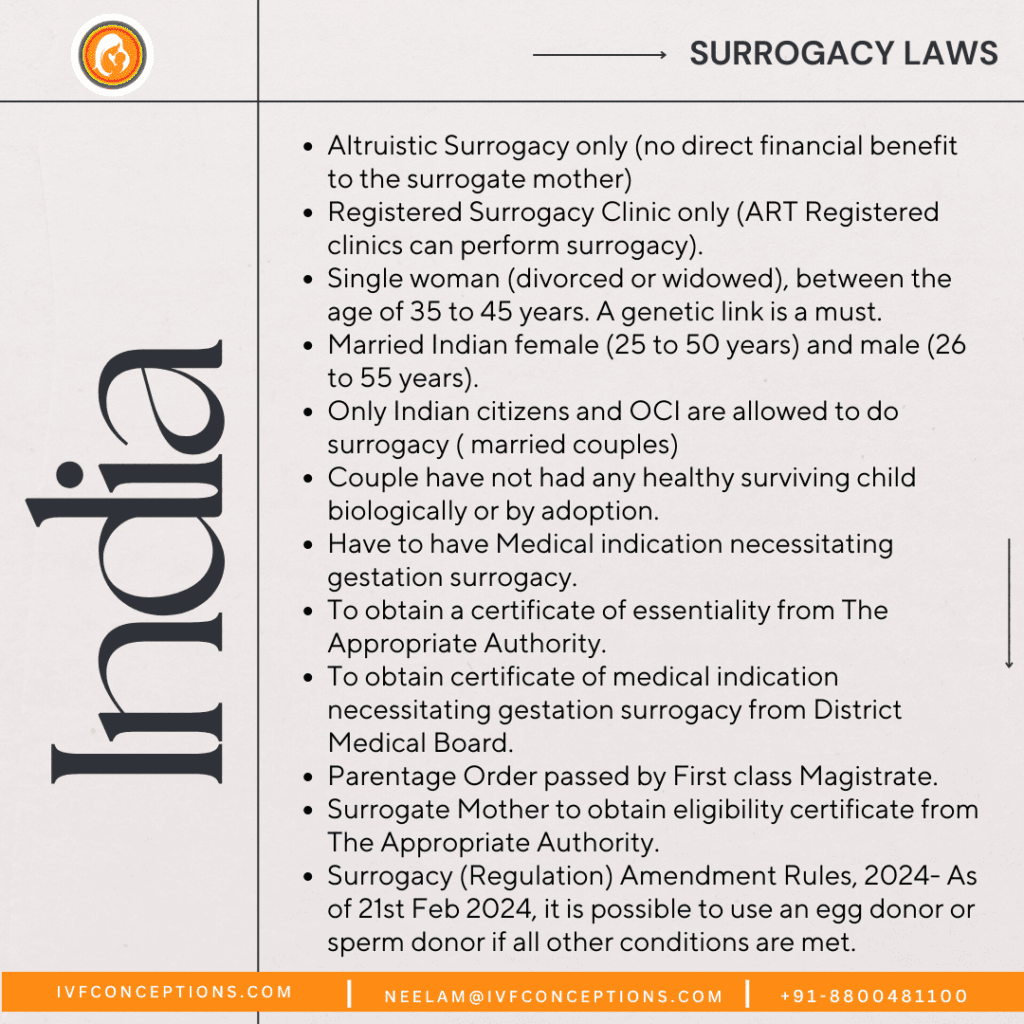
latest surrogacy laws in India
🌍Alternative Surrogacy Destinations for Canadians
If Indian regulations are too restrictive, Canadian intended parents can consider other international surrogacy destinations:
| Country | Eligibility | Average Cost (USD) |
| Mexico | Allows LGBTQ+, singles | \$50,000 – \$70,000 |
| Colombia | Inclusive & legally clear | \$55,000 – \$75,000 |
| Georgia | Only for married heterosexuals | \$45,000 – \$60,000 |
| Ukraine | Suspended for international IPs due to war | N/A |
| Argentina | Public health system access | \$40,000 – \$55,000 |
📣 Conclusion for Altruistic Surrogacy in India for Canadian citizens with OCI cards
Yes — but only if you meet India’s strict altruistic surrogacy requirements.
Canadian citizens with OCI cards can pursue surrogacy in India legally, provided they:
- Are married heterosexuals,
- Use a close female relative as a surrogate,
- Have documented infertility or medical needs, and
- Follow all guidelines set by India’s ART and Surrogacy Boards.
For those who don’t qualify or face logistical challenges, other destinations like Mexico or Colombia may offer more inclusive and flexible options.
Building a family through trusted partnerships requires careful planning and ethical foundations. The framework discussed offers secure legal pathways paired with advanced medical care, creating opportunities for eligible couples to realize their parenting goals.
📞 Get in Touch for a Free Surrogacy Consultation
📱 +91-8800481100 (WhatsApp | LINE | Viber)

Altruistic Surrogacy in India for Canadian citizens with OCI cards
FAQs for Altruistic surrogacy in India for Canadian citizens with OCI
Can Canadian OCI cardholders pursue surrogacy arrangements in India?
Yes, under the Surrogacy (Regulation) Act 2021, overseas citizens of India with valid OCI status may pursue altruistic gestational surrogacy if they meet eligibility criteria, including proven infertility and marriage duration of at least 2 years.
What legal protections exist for intended parents under India’s 2021 surrogacy laws?
The law mandates court-approved agreements, medical screenings for surrogates, and prohibits commercial compensation. Parental orders must be secured pre-birth, with citizenship applications filed through Canadian diplomatic channels post-delivery.
How do costs compare to other international surrogacy destinations?
While India remains cost-effective due to lower medical expenses, the altruistic model eliminates agent fees. Typical budgets cover IVF procedures, prenatal care, legal filings, and reasonable surrogate support expenses as defined by law.
What clinic credentials ensure ethical practices?
Verify ART clinic registration with the National Registry, embryologist certifications, and documented compliance with ICMR guidelines. Reputable facilities provide transparent success rates for embryo transfers and frozen cycles.
How are parental rights established post-delivery?
Intended parents obtain a birth certificate through the Indian courts listing them as legal guardians. Canadian citizenship applications require DNA testing, embassy affidavits, and passport processing via the High Commission.
Are surrogate compensation payments permitted?
Only reimbursements for medical costs, insurance premiums, and pregnancy-related expenses are allowed. The law strictly prohibits commercial agreements, requiring ethical oversight from registered surrogacy boards.
What IVF success rates should clinics demonstrate?
Leading facilities maintain 55-65% success rates for women under 35 using tested embryos. Clinics should provide cycle-specific statistics and individualized protocols based on genetic screening results.
What documentation is required before embryo transfer?
Essential documents include marriage certificates, medical necessity affidavits, OCI cards, and eligibility certificates from India’s State Surrogacy Board. Notarized agreements must outline all parties’ responsibilities.
How long does the entire process typically take?
From initial consultations to birth, expect 18-24 months. Timelines depend on embryo creation success, surrogate matching, and legal approvals. Post-delivery documentation adds 8-12 weeks for international parents.
Can same-sex couples pursue these arrangements?
Current regulations restrict access to heterosexual married couples. The 2021 Act requires intended parents to provide proof of marriage recognized in their home country and in India.
Additional resources:
🌐 https://www.completesurrogacy.com/
🌐 https://www.georgiasurrogacyagency.com/