
Who Is Legally Eligible for Surrogacy in India in 2026
Is surrogacy legal in India
The Surrogacy (Regulation) Act of 2021 established strict guidelines that determine who can pursue this family-building option. Understanding these regulations is crucial for anyone considering this journey.
Recent amendments have clarified that only specific categories of individuals meet the requirements. Indian married couples must fulfill several conditions, including marriage duration and age parameters. The law also extends opportunities to certain single women and OCI cardholders.
This framework emphasizes medical necessity over lifestyle choice. It requires documented proof of infertility and follows an altruistic model where commercial arrangements are prohibited.
Key Takeaways
- The Surrogacy (Regulation) Act, 2021 governs all surrogacy arrangements in India
- Only altruistic surrogacy is permitted, banning commercial compensation
- Indian married couples must meet specific age and marriage duration requirements
- Single women who are widowed or divorced have limited eligibility between the ages 35-45
- OCI cardholders now have the same rights as resident Indian citizens
- Medical certification of infertility is mandatory for all applicants
- Foreign nationals without OCI status and same-sex couples are currently excluded
📞 Get in Touch for a Free Surrogacy Consultation
📱 +91-8800481100 (WhatsApp | LINE | Viber)
📧 neelam@ivfconceptions.com
http://www.completesurrogacy.com
Why Intended Parents Choose Complete Surrogacy for a Safe, Smooth & Successful Surrogacy Journey:
🌍 Access to multiple surrogacy destinations with 15+ years of international experience
🏥 Partnerships with top-tier fertility clinics and agencies, backed by references from past clients
👩🦱 Diverse egg donor options: Asian, Caucasian, African, Oriental, and more
💸 Transparent and affordable pricing—direct payments with no extra agency fees
🔒 No hidden costs—all charges are agreed upon upfront
🤝 Dedicated case manager for personalized support
📲 Fast, honest, and clear communication throughout
📑 Full legal support for visas, documentation, and baby exit processes
Additional guides for surrogacy in India:
Is Single Parent Surrogacy Legal in India- Your Guide for Surrogacy in India
Cost of Altruistic Surrogacy in India: A Complete Guide
Surrogacy in India for OCI Card Holders: Navigating the Process
What is the Legal Procedure for Surrogacy in India
Top Surrogacy Agency in India: Your Best Choice

Altruistic Surrogacy in India for Canadian citizens
Overview of Surrogacy in India Today
India’s approach to surrogacy has evolved significantly, moving from a commercial hub to a strictly regulated, altruistic system. This journey provides a crucial foundation for understanding the current legal framework.
Defining Surrogacy and Its Importance
At its core, surrogacy is an arrangement where a woman, the surrogate mother, carries a pregnancy to term for intended parents. It represents a beacon of hope for those facing medical barriers to conception.
The most common and legally accepted form is gestational surrogacy. Here, an embryo created via IVF from the intended parents’ or donors’ genetic material is implanted. This means the surrogate mother has no biological link to the baby.
Historical Perspective and Recent Changes
Historically, India was a popular global destination for surrogacy. Affordable costs and advanced medical facilities attracted international couples. However, this led to ethical concerns about the potential exploitation of women from vulnerable backgrounds.
Recognizing these issues, the government introduced the Surrogacy (Regulation) Act, 2021. This law fundamentally transformed the landscape. It banned commercial arrangements and permits only altruistic gestational surrogacy.
Today, surrogate mothers cannot receive financial payment beyond medical and insurance coverage. This shift aims to protect women’s dignity and ensure surrogacy is an act of compassion, not financial necessity.
Surrogacy Regulations: Understanding the Latest Law
India’s surrogacy regulations have been completely rewritten to prioritize ethical considerations and participant protection. The Surrogacy (Regulation) Act of 2021, with subsequent amendments, establishes a comprehensive framework that governs all arrangements.
Key Provisions of the Surrogacy (Regulation) Act
The law makes a clear distinction between permitted and prohibited practices. Commercial surrogacy, where financial compensation is provided beyond medical expenses, is completely banned.
Only altruistic surrogacy is legally recognized. This model prohibits any payment to the surrogate mother for her reproductive services. Intended parents can only cover medical costs, insurance, and pregnancy-related expenses.
Violations carry severe penalties, including imprisonment up to 10 years and substantial fines. The law applies equally to all parties involved in the surrogacy process.
Shift from Commercial to Altruistic Surrogacy
This fundamental change addresses historical concerns about exploitation. The previous system of commercial surrogacy raised issues about women’s rights and economic coercion.
The new framework ensures surrogacy arrangements stem from genuine compassion rather than financial necessity. It protects vulnerable women while upholding ethical standards in reproductive medicine.
The mandatory 36-month insurance coverage provides long-term security for surrogate mothers. This demonstrates the law’s commitment to protecting participants’ health and rights.
Who Is Legally Eligible for Surrogacy in India in 2026
Understanding whether you meet the necessary conditions to pursue this family-building option involves several key factors. The current framework establishes clear parameters for different participant categories.
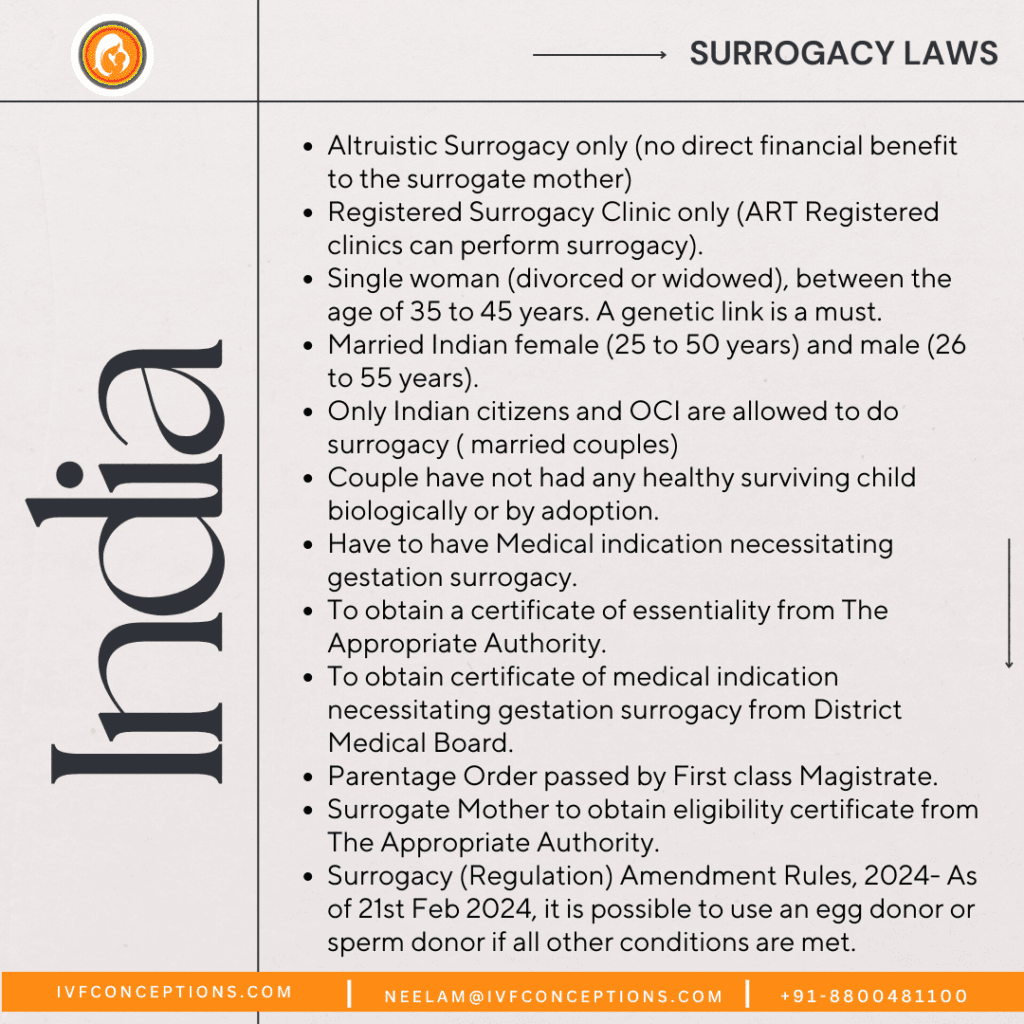
For Indian couples, specific marriage and age requirements apply. The woman must be 23-50 years old, while the men should be 26-55. A minimum five-year marriage duration is mandatory.
Medical certification of infertility from authorized specialists proves essential. This demonstrates the arrangement addresses genuine medical necessity rather than convenience.
Single women have limited eligibility. Only widowed or divorced individuals aged 35-45 can apply. They must use their own eggs, prohibiting donor usage.
OCI and NRI cardholders now share the same rights as resident citizens. They must satisfy all other criteria applicable to Indian couples.
The law explicitly excludes several groups. Foreign nationals without Indian origin cannot access these services. Same-sex couples, live-in partners, and single men are also prohibited.
Verifying your eligibility before beginning the process saves time and emotional investment. Consulting with registered clinics ensures proper guidance through India’s surrogacy regulations.
Eligibility Criteria for Intended Parents
The criteria for couples seeking surrogacy arrangements focus on relationship stability and medical necessity. These requirements ensure the process serves those with genuine need while protecting all participants.
Intended Parents Eligibility Criteria (India, under the new Surrogacy Act)
If you are planning surrogacy in India, these are the key requirements you must meet:
- For Married Couples
- Husband must be 26–55 years old.
- Wife must be 23–50 years old.
- For Single Women
- Only widows or divorcees are eligible.
- Age must be within 23–50 years.
- Can use a sperm donor, but egg donation is not allowed.
- For Couples of Indian Origin
- Both partners must hold OCI (Overseas Citizen of India) cards.
- Application Process
- Must apply in their resident district/ward.
- Medical & Legal Guidelines
- Couples cannot already have a healthy biological child.
- Egg donor cycles are permitted, but embryo import from abroad is not allowed.
- Embryos may be transferred between registered clinics within India.
- Sex selection is strictly prohibited.
- A Certificate of Medical Indication must be obtained from the District Medical Board.
- A Certificate of Essentiality is required before starting the process.
- A Parental Order must be issued by a First-Class Magistrate for both the couple and the surrogate.
- For the Surrogate Mother’s Protection
- She must be covered under general health insurance for 36 months.
- An affidavit must guarantee compensation in case of complications.
- Clinic Requirement
- Surrogacy must be carried out only through a ART registered surrogacy clinic, as per the new Act.
Marriage Duration and Age Requirements
Prospective parents must demonstrate relationship commitment through a minimum five-year marriage. This timeframe confirms stability before undertaking the complex surrogacy journey.
Age parameters are carefully calibrated for safety. The female partner should be 23-50 years old, while the male partner must be 26-55 years. These ranges balance reproductive health with parental readiness.
Medical Necessity and Infertility Proof
Medical necessity forms the cornerstone of eligibility. You cannot choose surrogacy for convenience—it requires documented medical barriers to pregnancy.
A Certificate of Essentiality from a District Medical Board proves this necessity. Qualifying conditions include uterine absence, repeated IVF failures, or health risks making pregnancy dangerous.
The framework typically requires that the couple have no surviving children. Compassionate exceptions exist for parents of children with life-threatening conditions.

Is Surrogacy Banned in India
Legal Requirements for Surrogate Mothers
The legal framework establishes specific protective criteria for the woman who chooses to become a surrogate mother. These regulations prioritize her well-being throughout the journey.
Health, Psychological, and Age Criteria
A surrogate must be between 25 and 35 years of age. This range ensures optimal physical health for pregnancy while minimizing risks.
She must undergo comprehensive medical and psychological evaluations. These assessments confirm she’s physically and emotionally prepared for the process.
The surrogate mother must be married and have at least one biological child. This requirement proves she understands pregnancy’s physical and emotional demands.
Family Relationship and Consent Requirements
Originally, the law required the surrogate to be a close relative. Recent amendments now accept any willing woman who meets all criteria.
Informed written consent is mandatory. The surrogate mother must understand her rights, including withdrawal before embryo transfer.
She can only serve as a surrogate once in her lifetime. This prevents potential exploitation and protects her long-term health.
Procedural Steps for Legal Surrogacy in India

Is Surrogacy Banned in India
Navigating the legal pathway to surrogacy in India requires careful attention to a multi-stage approval process. This structured procedure is designed to protect everyone involved and ensure full compliance with the law.
You must complete several key steps before any medical treatment can begin. Understanding this sequence helps manage expectations and timelines effectively.
Documentation and Certification Process
The first phase involves gathering extensive paperwork. Intended parents need to provide identity proofs, marriage certificates, and medical fitness reports.
The surrogate mother must also submit similar documents, including a notarized affidavit of her informed consent. This proves she willingly participates and understands her rights.
Two specific certificates are mandatory for the procedure to move forward. Without them, no clinic can legally perform an embryo transfer.
| Certificate | Issuing Authority | Primary Purpose |
|---|---|---|
| Certificate of Essentiality | District Medical Board | Confirms medical necessity for surrogacy based on infertility. |
| Certificate of Eligibility | State Appropriate Authority | Verifies that intended parents meet all legal criteria for surrogacy. |
Approval from State and District Boards
After compiling documents, you must seek formal approval. The District or State Surrogacy Board reviews the entire application package.
This review process verifies that all procedures have been correctly followed. It includes checking the legal agreement between the parties.
Board approval can take several weeks. Working with experienced legal counsel familiar with these procedures is highly recommended to navigate this phase smoothly.
The Surrogacy Medical and Legal Journey
The medical journey of surrogacy transforms legal approval into a biological reality through carefully coordinated procedures. This phase requires close collaboration between fertility specialists, intended parents, and the surrogate mother.
After securing all necessary legal clearances, the medical process begins with hormonal preparation. The intended mother or egg donor receives medications to optimize egg production over several weeks.
IVF, Embryo Transfer, and Pregnancy Monitoring
Gamete collection involves retrieving egg cells and sperm samples. These are immediately preserved through cryopreservation to maintain viability for the IVF procedure.
Fertilization occurs in a controlled laboratory environment where egg and sperm combine. The resulting embryo develops for several days before selection.
“The precision of modern reproductive technology allows for careful embryo development monitoring, ensuring the healthiest possible start.”
The embryo transfer is a minor outpatient procedure. A specialist places the selected embryo into the surrogate’s uterus using a thin catheter.
| Medical Stage | Duration | Key Participants |
|---|---|---|
| Hormonal Preparation | 4-8 weeks | Intended mother/donor |
| Embryo Development | 5-6 days | Laboratory specialists |
| Pregnancy Monitoring | Full term | Surrogate & medical team |
Throughout the pregnancy, the surrogate receives comprehensive care, including regular ultrasounds and nutritional support. This monitoring ensures both her health and the baby’s development.
After the embryo transfer, the surrogate begins progesterone support. Continuous screening tracks fetal growth during the entire pregnancy journey.
Postnatal care extends beyond delivery, providing medical follow-up for the surrogate while intended parents receive newborn guidance. This complete process supports everyone involved in the surrogacy journey.
Surrogacy Cost in India Breakdown
Planning your finances is a crucial step in the surrogacy journey. Understanding the permitted expenses helps you budget effectively for this significant life event.
The total cost for a legal surrogacy arrangement in India typically falls between ₹20 and ₹30 lakhs. This covers all medical, legal, and administrative fees under the altruistic model.
Medical, Legal, and Insurance Expenses
Your investment is divided into several key categories. Each serves a specific purpose in ensuring a safe and legally compliant process.
- IVF and Embryo Transfer: This medical procedure represents a substantial portion of the cost.
- Surrogate Care and Insurance: A mandatory 36-month insurance policy is a fixed cost. It provides comprehensive insurance coverage for the surrogate.
- Legal and Administrative Fees: These cover the complex documentation required by the new regulations.
- Hospital Delivery: Charges vary based on the type of delivery and any neonatal care needed.
- Clinic Coordination: Some intended parents opt for agency or clinic management services.
It is vital to know that no financial compensation can be paid to the surrogate beyond these categories. Any additional payment is illegal.
Comparative Costs with Other Countries
India remains a financially accessible option compared to many Western countries. The total cost is significantly lower.
In the United States, surrogacy can exceed $100,000. Other international options often range from $50,000 to $70,000.
While costs in India have risen due to enhanced legal safeguards, it offers a balanced approach of affordability and ethical practice. Consulting with a registered clinic will provide a precise estimate for your situation.
Guidelines for NRI, OCI couples for surrogacy in India

For couples of Indian origin living abroad, the surrogacy pathway requires careful navigation of both citizenship status and residency requirements. Recent legal updates have clarified that these couples have the same rights as resident Indian citizens, provided they meet specific criteria.
Residency and Citizenship Specifications
If you hold NRI or OCI status, you must demonstrate a minimum 12-month residency in India before applying. This ensures your commitment to the process and availability for medical appointments.
PIO cardholders need to convert their status to OCI first, as the PIO scheme has merged with the OCI framework. Foreign nationals without Indian origin status remain prohibited from accessing these services.
| Document Type | Specific Requirement | Purpose |
|---|---|---|
| Passport & Visa | Valid copies with current status | Proof of identity and legal entry |
| OCI/NRI Certificate | Official documentation | Confirms Indian origin status |
| Residency Proof | 12-month stay evidence | Demonstrates commitment to process |
Required Certifications and Documents
Beyond standard eligibility criteria, you’ll need medical certification from a registered Indian IVF clinic. International medical reports alone won’t satisfy the District Medical Board’s requirements.
The approval process mirrors that for resident couples. You must obtain both the Certificate of Essentiality and Certificate of Eligibility from the appropriate surrogacy boards.
Post-birth procedures involve obtaining the child’s Indian birth certificate and FRRO exit clearance. Your embassy may need to provide a letter confirming your country recognizes surrogacy arrangements.
Conclusion
The path to building your family through surrogacy in India represents a carefully regulated journey of hope. This framework ensures ethical practices while supporting intended parents pursuing parenthood.
Understanding the current regulations empowers you to navigate this complex process confidently. The system prioritizes the well-being of the surrogate mother and the child through comprehensive safeguards.
While the journey demands patience and diligence, it offers a legitimate path to parenthood. Thousands of families have successfully completed this meaningful surrogacy process.
With proper planning and expert guidance, you can move forward with confidence toward your dream of building a family.
📞 Get in Touch for a Free Surrogacy Consultation
📱 +91-8800481100 (WhatsApp | LINE | Viber)
📧 neelam@ivfconceptions.com