

Can OCI Cardholders Do Surrogacy in India in 2026?
Yes. Under the Surrogacy (Regulation) Rules, 2022, a “couple of Indian origin” — a married couple where both husband and wife are Overseas Citizens of India (OCI) cardholders — may apply for altruistic surrogacy in India, subject to all conditions of the Surrogacy (Regulation) Act, 2021. Commercial surrogacy is banned, and the surrogate can only receive her medical expenses and insurance. Because implementation can vary, we recommend confirming your case with the Appropriate Authority of the state where you plan to do surrogacy.
Under the current framework, only altruistic surrogacy is permitted in India. Commercial surrogacy is prohibited. Intended parents must obtain the necessary medical certificates, legal approvals, and documentation before beginning the surrogacy process. The surrogate mother must also meet the eligibility conditions specified under Indian law.
At IVF Conceptions, we help OCI cardholders understand the latest surrogacy regulations in India, coordinate with experienced fertility specialists, and guide them through documentation, legal compliance, IVF treatment planning, and embryo transfer. Our team works closely with trusted fertility clinics and legal professionals to ensure every step of the process follows the applicable Indian regulations.
As surrogacy laws and government guidelines may be updated, OCI cardholders should always seek professional legal and medical advice before proceeding. IVF Conceptions provides transparent guidance to help intended parents navigate the surrogacy journey in India with confidence while remaining fully compliant with the law.
Key Takeaways for- Surrogacy in India Allowed for OCI Cardholders?
✔️ Married couples where both partners hold OCI cards are covered under the Surrogacy Rules.
✔️ Only altruistic surrogacy is allowed; the surrogate cannot be paid.
✔️ Female partner 23–50 years, male partner 26–55 years.
✔️ A medical indication certified by the District Medical Board is required.
✔️ Foreign nationals without an OCI card, single men and same-sex couples are not eligible.
Additional guides for surrogacy in India for OCI:
Surrogacy law in India
Surrogacy for NRI in India
Surrogacy cost in India
Get in touch for FREE SURROGACY CONSULTING
-
OCI and surrogacy in India
-
can OCI holders do surrogacy in India
-
latest surrogacy rules for OCI in India
-
if surrogacy legal for OCI cardholders India, assess your specific case with our legal and medicla team
-
Indian surrogacy for foreign nationals/OCIs
-
surrogacy eligibility for overseas Indians – your eligibility check and personalized guide
Get in touch for FREE SURROGACY CONSULTING for OCI & Surrogacy in India: Updated Eligibility 2026
Mobile: +91-8800481100 ( WhatsApp, Line, Viber)
Email: neelam@ivfconceptions.com

 Surrogacy Regulations in India for OCI Couples
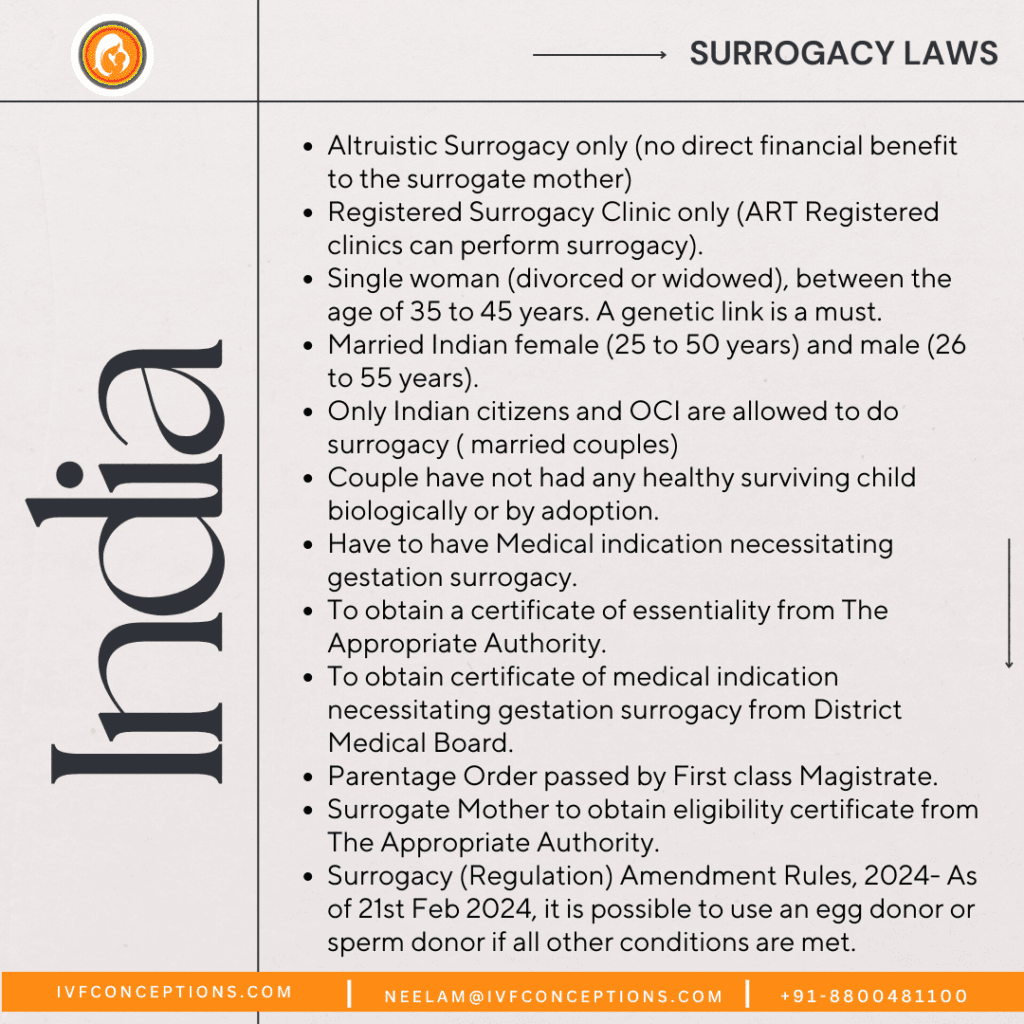
Surrogacy in India is governed by the Surrogacy (Regulation) Act, 2021, the Surrogacy (Regulation) Rules, 2022, and the Amendment Rules, 2024. The key rules for OCI couples are:
THE SURROGACY (REGULATION) ACT, 2021
- Altruistic Surrogacy only (no direct financial benefit to the surrogate mother)
- Registered Surrogacy Clinic only (ART Registered clinics can perform surrogacy).
- Single woman (divorced or widowed), between the age of 35 to 45 years. A genetic link is a must.
- Married couple where both partners hold OCI cards: female 23–50 years, male 26–55 years.
- Indian citizens (including NRIs) and couples where both partners are OCI cardholders.
- The couple has not had any healthy surviving child biologically or by adoption.
- Have to have a Medical indication necessitating gestation surrogacy.
- To obtain a certificate of essentiality from The Appropriate Authority.
- To obtain a certificate of medical indication necessitating gestation surrogacy from the District Medical Board.
- Parentage Order passed by First Class Magistrate.
- Surrogate Mother to obtain eligibility certificate from The Appropriate Authority.
- Surrogacy (Regulation) Amendment Rules, 2024- As of 21st Feb 2024, it is possible to use an egg donor or sperm donor if all other conditions are met.
Who Is Eligible for Surrogacy in India?
| Criteria | Details |
|---|---|
| Allowed Intended Parents | OCI holders married for at least 2 years |
| Age Requirement | Male: 26-50 years, Female: 23-50 years |
| Medical Condition | A certificate proving infertility is required |
| Legal Documents | NOC, embassy letter, and FRRO approval required |
| Surrogate Mother Requirements | Must be a married woman (25-35 years) with at least one biological child |
🔹 Single parents, same-sex couples, and foreigners (non-OCI) are not eligible.
What is Altruistic Surrogacy in India
Altruistic surrogacy in India is a legally regulated form of surrogacy in which a surrogate mother carries and delivers a baby for the intended parents without receiving any financial compensation for the pregnancy. The surrogate is only reimbursed for legally permitted expenses, such as medical treatment, pregnancy-related healthcare, insurance, and other approved costs under the applicable law.
Unlike commercial surrogacy, altruistic surrogacy is based on the intention to help individuals or couples who are unable to carry a pregnancy due to medical reasons. The process involves In Vitro Fertilization (IVF), where an embryo is created using the intended parents’ or donors’ egg and sperm and then transferred to the surrogate’s uterus. In gestational surrogacy, the surrogate has no genetic relationship to the baby.
In India, the Surrogacy (Regulation) Act, 2021 permits only altruistic surrogacy for eligible intended parents who meet the prescribed legal and medical criteria. The process requires medical evaluations, legal documentation, and compliance with government regulations before treatment begins.
What is the Altruistic Surrogacy Process in India (2026)?
As of 2026, altruistic surrogacy is the only legally permitted form of surrogacy in India under the Surrogacy (Regulation) Act, 2021 and related rules. Commercial surrogacy is prohibited. Eligible intended parents, including those covered under the applicable legal framework, must meet the prescribed medical, legal, and documentation requirements before starting treatment.
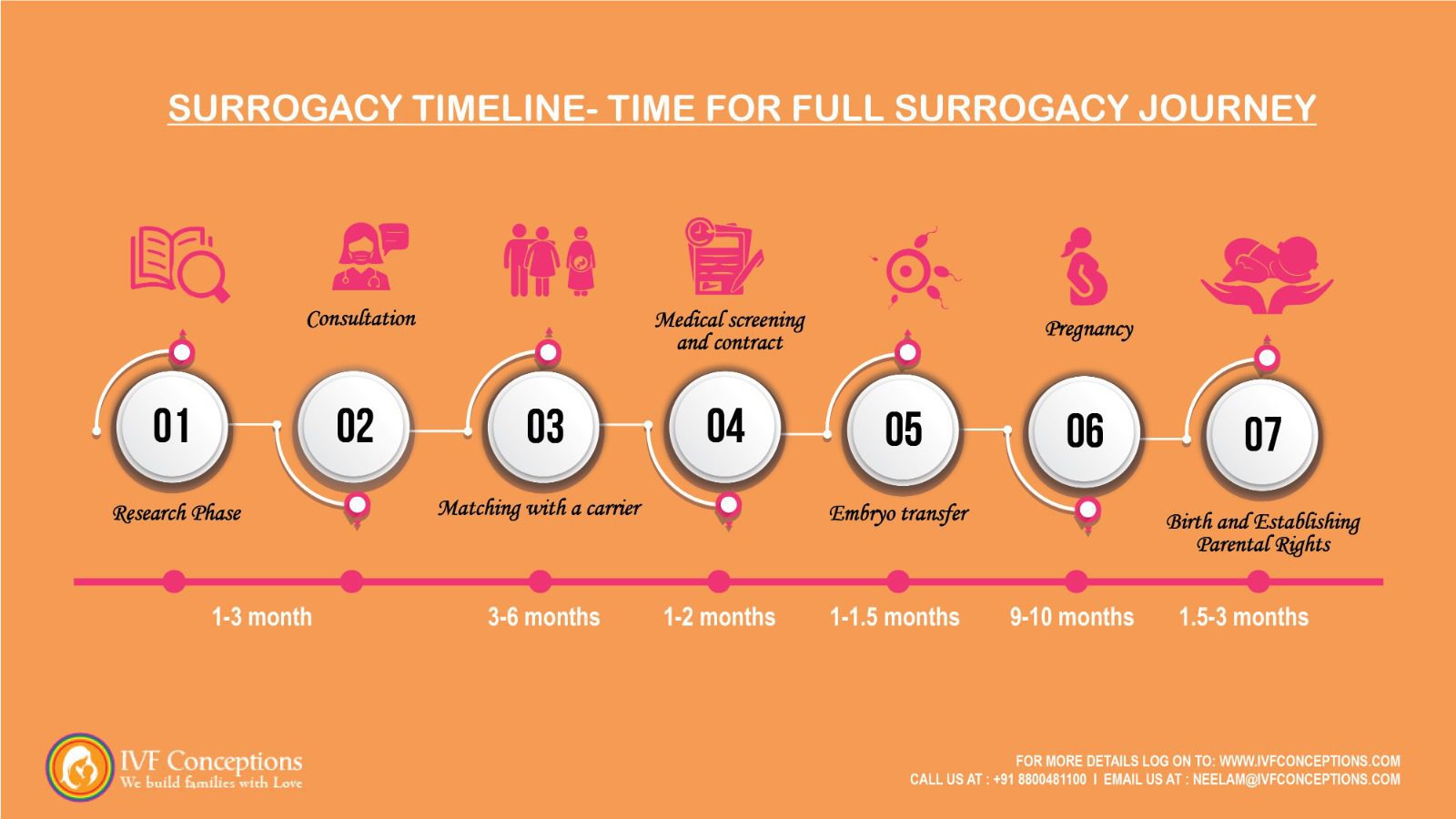
The process begins with a consultation at a registered fertility clinic, where specialists evaluate the intended parents and confirm whether surrogacy is medically indicated. The intended parents and the surrogate mother undergo medical screening, psychological assessment, and legal verification to ensure eligibility.
Once all approvals and documentation are completed, the IVF process starts. Eggs and sperm from the intended parents or eligible donors, where legally permitted, are used to create embryos. A healthy embryo is then transferred to the surrogate’s uterus at a registered ART clinic.
After pregnancy is confirmed, the surrogate receives regular prenatal care, medical monitoring, and pregnancy support until delivery. Following the birth, the legal procedures are completed in accordance with Indian law, and the baby is handed over to the intended parents.
What is an OCI (Overseas Citizenship of India) Cardholder?
The Overseas Citizenship of India is an immigration position in which a foreign citizen of Indian origin can live and work in India indefinitely. Such people do not need to take any permission or visa for arrival, at any time, for any number of days.
In August 2005, OCI was introduced by the Citizenship (Amendment) Act. According to the Constitution of India, an Indian citizen can only have one citizenship.
OCI is different from NRI status. An NRI is an Indian citizen with an Indian passport living abroad and follows the same rules as Indian couples. Read our NRI surrogacy guide.
An overseas citizen of India is not a citizen of India
An overseas citizen of India is not a citizen of India, so come up with some limits like they cannot vote, take constitutional offices, buy agricultural properties, etc. To apply for an OCI document, the person needs to be a citizen of some other country and should have a passport of their country, except for Bangladesh or Pakistan.
 So, how can an OCI apply for surrogacy in India?
Current Surrogacy Process in India
Please read below the basic Surrogacy steps:
#1. Intended Parents eligibility
- Intended parents need to be eligible on multiple levels, legally, medically, nationality, age, etc. You will find the list of criteria mentioned here. Click to learn more.
#2. Surrogacy Legal Documentation
- This is the most important event in the process of surrogacy, where the legal team will guide you through the new laws and processes.
- Prepare the affidavits, agreements, and other documents. Will file it to the relevant authorities for approval.
#3. NOC and Court order
- You need an essentiality certificate from the Appropriate authority and the Board. Post which the Court needs to provide the Court order.
#4. Surrogate Verification
- Surrogate post verification from the Appropriate Authority will undergo endometrial preparation and get ready for transfer.
#5. IVF Process
- Once we have all the documents in place, we can start the IVF process, surrogate preparation, and plan for a transfer date.
#6. Ante-natal Care (Pregnancy)
- We regularly communicate with you in regards to the progress of the pregnancy and surrogate care throughout the 9 months.
#7. Coordinating Delivery
- Close to the delivery date, we help plan the delivery and the requirements.
- At birth, the baby will be handed over to you, and you need to stay in the hospital for 2-3 days to ensure everything is good for the baby.
#8. Closure of Surrogacy
- Post one or two months of delivery, once the surrogate is healthy, she signs off on an NOC, which gives closure for the program.
More resources for Surrogacy in India. For Overseas Citizenship of India (OCI) :
What is surrogacy law in India?
All you need to know about the surrogacy process in India
How much does surrogacy cost in India?
Surrogacy Cost Breakdown in India for OCI Holders
The cost of surrogacy for OCI couples is the same as for Indian couples, plus travel and stay. Costs cover IVF, the surrogate’s medical care and insurance, legal work and delivery; the surrogate cannot be paid a fee. See the full breakdown in our guide to surrogacy cost in India.
Challenges & Considerations in OCI Surrogacy
🔴 Legal Complexities: Surrogacy laws in India frequently change.
🔴 Medical Risks: IVF failure rates and pregnancy complications add unforeseen costs.
🔴 Baby’s documents: The birth certificate, passport and exit formalities can take time.
🔴 Surrogate Screening: Finding qualified surrogates willing to do unpaid altruistic surrogacy is challenging.

Surrogacy in India For Overseas Citizenship of India
Why OCI Couples Choose IVF Conceptions
Why Intended Parents Choose Complete Surrogacy for a Safe, Smooth & Successful Surrogacy Journey:
🌍 Access to multiple surrogacy destinations with 15+ years of international experience
🏥 Partnerships with top-tier fertility clinics and agencies, backed by references from past clients
💸 Transparent and affordable pricing—direct payments with no extra agency fees
🔒 No hidden costs—all charges are agreed upon upfront
🤝 Dedicated case manager for personalized support
📲 Fast, honest, and clear communication throughout
📑 Full legal support for visas, documentation, and baby exit processes
To confirm all this, can you provide the following details to see if we can assist you with surrogacy in India legally?
- Female Partner Age:
- Male Partners’ Age:
- Citizenship:
- Marital status:
- Any child?:
- Medical reason for surrogacy:
- Self or donor cycle:
- Present location:
If you are not eligible for surrogacy in India, we can offer it in other countries as well. We are happy to set up a consultation call to discuss your options and provide further assistance if needed.
Final Thoughts: Is Surrogacy in India a Good Option for OCI Holders?
Surrogacy in India is an affordable and legally secure option for OCI holders who meet strict eligibility criteria. While the process is complex, it remains one of the most budget-friendly alternatives compared to the USA, Canada, or Georgia.
📌 Need Expert Guidance on OCI Surrogacy? 📩 Get a free consultation with a surrogacy expert today!
🌍 Website: www.ivfconceptions.com
📧 Email: neelam@ivfconceptions.com
📲 WhatsApp/Viber/Line: +91-8800481100

FAQs Surrogacy in India for Overseas Citizenship of India (OCI)
What are the surrogacy-related rules for OCI Cardholders?
The 2015 MHA circular that stopped OCI surrogacy was issued before the Surrogacy (Regulation) Act, 2021. Under the 2022 Rules, couples where both partners hold OCI cards are covered as a “couple of Indian origin”, subject to all conditions of the Act.
Is surrogacy in India for NRI (Non-Resident Indians) allowed?
Yes, if both partners hold Indian passports and meet all conditions. Read our NRI surrogacy guide.
Can OCI get surrogacy in India?
Yes, if both husband and wife are OCI cardholders and meet all conditions of the Act, including age limits and a certified medical indication.
Can an NRI opt for altruistic surrogacy in India?
Yes. NRIs are Indian citizens and follow the same rules as couples living in India.
Who is not eligible for altruistic surrogacy in India?
Foreign nationals without an OCI card, single men, same-sex couples, unmarried couples, and couples who do not meet the age or medical conditions.
Is surrogacy legal in India for Indian citizens?
Yes. Indian citizens can opt for altruistic surrogacy if they meet the conditions of the Surrogacy (Regulation) Act, 2021.
Is surrogacy for Indian parents possible in India?
Yes, possible but each case cannot be accepted. Please get in touch with us to discuss your specific case.
Is surrogacy legal in India for foreigners?
No. Foreign nationals cannot do surrogacy in India. Couples where both partners are OCI cardholders are covered under separate rules.
Q: Is commercial surrogacy banned in India?
A: Yes. Only altruistic surrogacy is allowed under the Surrogacy (Regulation) Act, 2021.
Q: Is surrogacy illegal in India? Is surrogacy in India is legal or not?
A: No. Surrogacy is legal in India, but only in altruistic form and only for eligible Indian citizens and OCI couples.
Single-man surrogacy legal in countries?
Countries such as the USA, Colombia, Mexico and Argentina offer options for single men. See our single parent surrogacy guide.
If you need below surrogacy consulting, we are happy to guide you.
-
is surrogacy in India allowed for OCI cardholders, check my unique case
-
surrogacy in India for OCI and PIO, am i eligible
-
surrogacy India law for overseas Indians
-
can OCI do surrogacy without residency in India
-
do OCI holders need Indian citizenship for surrogacy
-
legal status of surrogacy for OCI holders in India
-
eligibility criteria for OCI surrogacy
-
surrogacy cost implications for OCI
-
surrogacy process for OCI cardholders
More Resources:
- American Society for Reproductive Medicine (ASRM): https://www.asrm.org/
- The American Infertility Association (AIA): https://resolve.org/
- Family Equality Council: https://www.familyequality.org/
- National Center for Lesbian Rights (NCLR): https://www.nclrights.org/
- Ministry of External Affairs (India) – OCI Guidelines (https://www.mea.gov.in)
- Surrogacy (Regulation) Act, 2021 PDF (https://legislative.gov.in/)